


The joy of
country living
at Schloss Hof
The palace, the garden and nature stretching out to the horizon – at Schloss Hof, pleasure-seeking aristocrats moved in a Baroque synthesis of the arts. Everything was staged, nothing was left to chance. The opulence of days gone by can still be experienced here today. Enjoy an excursion for all the senses, with state rooms and a breathtaking Baroque garden with seven terraces!
The courtly playground
When Prince Eugene of Savoy acquired Schloss Hof in 1725, he commissioned Johann Lucas von Hildebrandt, one of the most important architects of the Baroque period, to transform the rather modest renaissance palace into a magnificent country residence. This provided his heirs, who wanted to sell the castle in 1754, with the ideal setting for the largest Baroque festival ever held here. They staged a three-day spectacle to convince the illustrious guests, including Empress Maria Theresa, of the uniqueness of the estate. The events even included an opera performance. All the game in the area was rounded up for a driven hunt to provide easy targets for the guests. That was too much even for the Empress: at her behest, the animals were released again.
Maria Theresa purchased the palace a year later. It turned out that Prince Eugene had collected everything that was good and expensive: rare animals, exotic plants, exquisite fabrics. The Regent was so enamoured of some of these fabrics that she had the originals reproduced and had sofas and walls – such as those in the Imperial Apartment – upholstered with them.
Today, the tradition of lavish entertainment continues with numerous events throughout the year that bring the Baroque period to life.
Tamed nature
Prince Eugene was not only a successful warlord, but also a passionate gardener. At Schloss Hof he created the most modern and technically sophisticated Baroque gardens in the Habsburg Empire: With seven terraces and six fountains – because water was the soul of the Baroque garden. With sculptures paying homage to him as lord of the palace and countless exotic plants. An illusionistic garden theatre of leaves and blossoms.
His passion for collecting botanicals was so great that his own agents would scout the Mediterranean ports for research ships and buy up exotic plants to send to Schloss Hof. Correspondence and conversations with his master gardener Anton Zinner have survived, showing that the two even discussed details such as the grafting of fruit trees.
At Schloss Hof today, visitors can still experience the tamed but lush nature of the Baroque era. The original Baroque state of the garden has been faithfully reconstructed from old paintings and excavations.
Tips

Baroque Gardens
Seven terraces restored to their Baroque splendour: with fountains, sculptures, a labyrinth, a viewing platform and much more, the garden at Schloss Hof is a sight to behold.
Idyllic Estate
Experience rural life in the Baroque era interactively and marvel at a colourful animal world: from white Baroque donkeys to old Austrian domestic breeds and exotic Bactrian camels.


Children’s paradise with a petting zoo
Children will have a great time at the Estate, with adventure playgrounds, a petting zoo, a balance bike course and a marble run.
200
animals live on the premises
365
windows offer views in and out
35.000
flowers in spring and summer bloom
Do you know what the characteristic feature of the white Baroque donkey is?
Its beautiful light blue eyes! It has them, because it is a so-called "Gelbling": It lacks pigmentation, which is why its coat is so pale and its skin is completely pink.
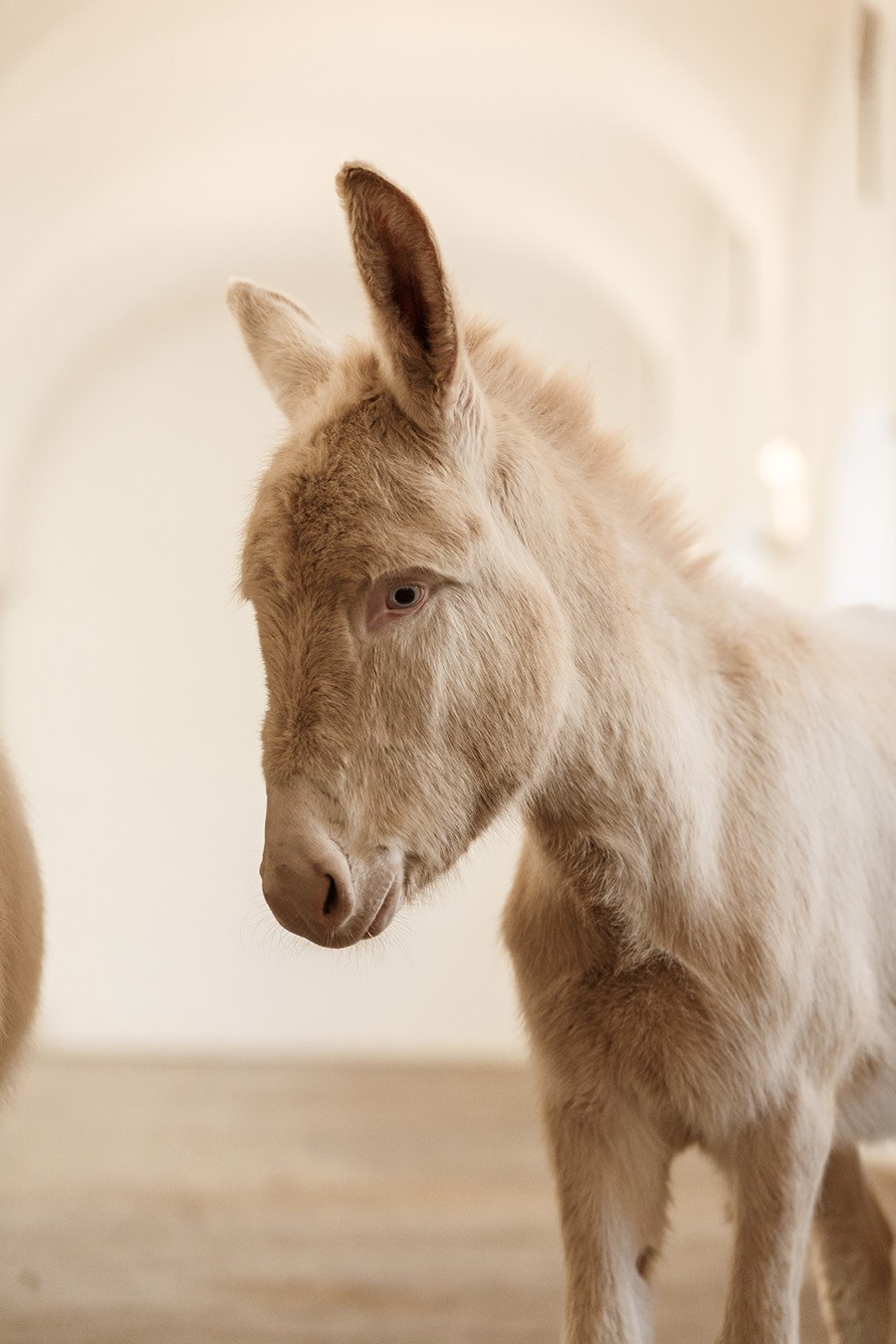
The colour of my coat is called Cremello!

Why don't you come and visit me at Schloss Hof?
Did you know that the white Baroque donkey is Austria’s only donkey breed?
Since 2016, the white Baroque donkey has been the only officially recognised breed of donkey in Austria. Proper breeding is subject to strict rules and regulations.
Did you know that the white Baroque donkey is very rare?
The white Baroque donkey is one of the domestic animal breeds threatened with extinction. There are only a few hundred of these special animals left in the world.

I am something of a rarity among long-eared animals!

I used to be a status symbol!
Do you know what the white Baroque donkeys used to be called?
Because of their bright colour, people called them "light bearers". They were very popular with the aristocracy, as the colour white was something very special in the Baroque period and was associated with goodness.
Do you know how long donkey mares are pregnant before the foal is born?
Donkey foals are born after twelve months in the womb. Like other donkey breeds, white Baroque donkeys can live to be 30 to 40 years old.

I have a fluffy coat right from the start!
